ANEKANTA LUXURY HAIR CARE
Botanical Intelligence.
Advanced Hair-Fibre Care.
Explore the botanical inspiration and cosmetic technologies used in modern hair care. This guide explains how selected plant constituents, cleansing agents, conditioning polymers, hydrolysed proteins and moisturising ingredients contribute to the feel, manageability and appearance of hair—and why the finished formula matters as much as any individual ingredient.

THE SCIENCE OF HAIR
Understanding the Hair Fibre
Effective hair care starts with understanding the structure of the hair strand and the cosmetic functions of the ingredients used to care for it. For a wider introduction, read our hair science explained guide.
01. Cuticle
The outermost layer of overlapping cells protects the inner hair fibre. Surface damage and raised or irregular cuticle edges contribute to friction, tangling and reduced shine.
Relevant care: Conditioning polymers, cationic conditioners and suitable emollients improve surface slip and cuticle feel.
02. Cortex
The cortex forms most of the hair shaft, containing keratin-rich structures responsible for much of its mechanical strength, elasticity and shape.
Relevant care: Hydrolysed proteins interact with damaged hair surfaces to improve feel and manageability.
03. Hair-Shaft Surface
Repeated washing, heat styling, chemical treatments and mechanical friction affect surface smoothness and fiber handling.
Relevant care: Cleansing, conditioning and lubrication work together to improve combability and reduce friction.
Cosmetic conditioning improves hair feel and manageability. It does not permanently repair damaged hair structure.
BOTANICAL COMPONENTS
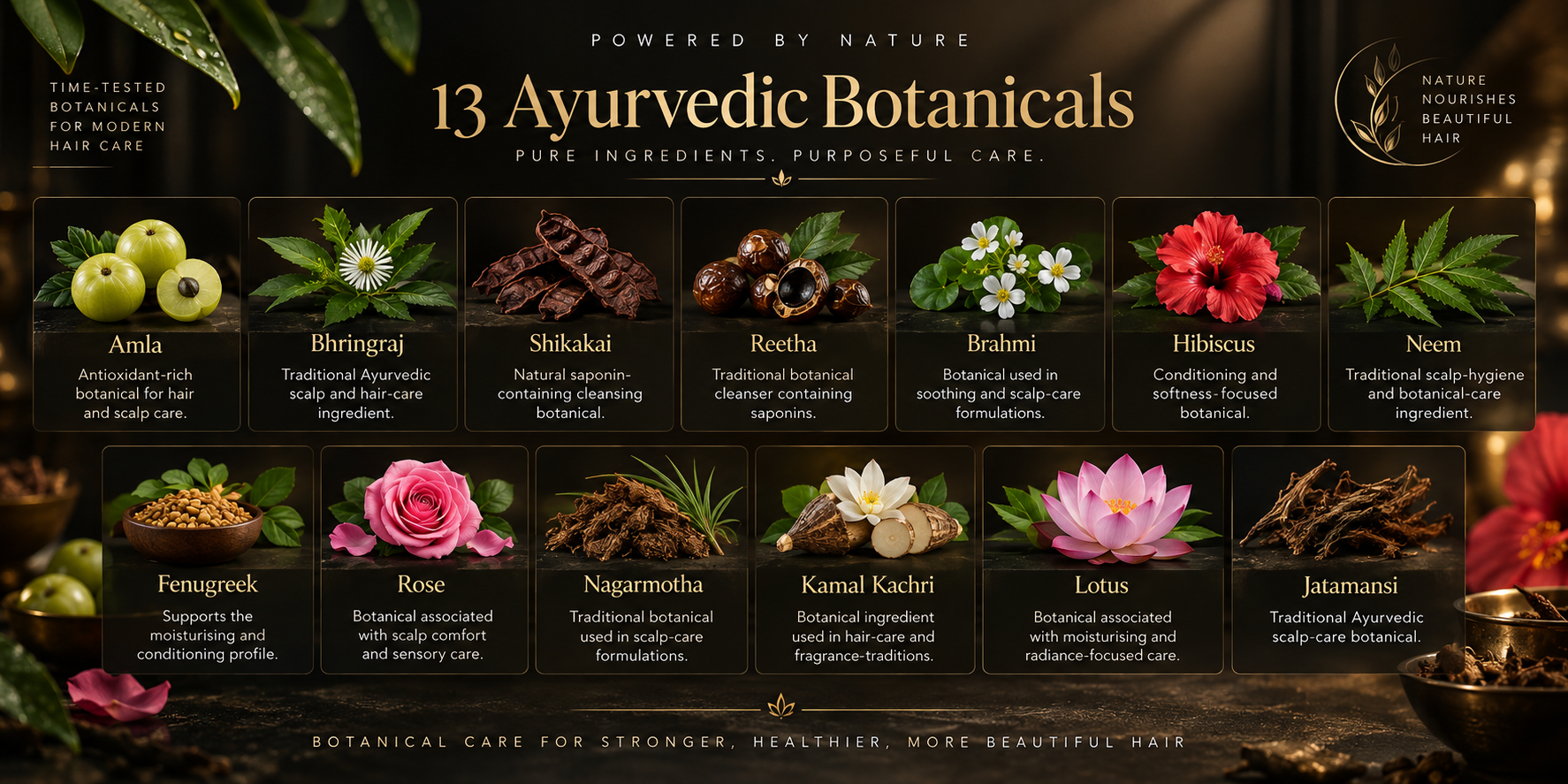
Ayurvedic Hair Care Ingredients: 13 Botanicals
Explore selected plant constituents among our Ayurvedic hair care ingredients and their relevance to cosmetic formulation. The exact composition of a botanical ingredient depends on its species, plant part, extraction method and processing.

Amla
Phyllanthus emblica
Reported Components
Tannins, including emblicanin-related compounds, and other polyphenolic constituents.
Hair-Care Relevance
Polyphenolic profile makes amla relevant to botanical antioxidant research. Contribution depends on extract and formulation.
Bhringraj
Eclipta prostrata
Reported Components
Wedelolactone and related coumestan compounds have been reported in the plant.
Hair-Care Relevance
Provides a defined phytochemical profile for botanical formulations. Not proven to repair the hair shaft directly.
Shikakai
Acacia concinna
Key Components
Naturally occurring saponins.
Hair-Care Relevance
Saponins contribute to traditional cleansing properties. Practical cleansing performance depends on preparation and concentration.
Reetha
Sapindus mukorossi
Key Components
Triterpenoid saponins.
Hair-Care Relevance
Surface-active plant constituents associated with cleansing. Formula mildness depends on the full surfactant system.
Brahmi
Bacopa monnieri
Reported Components
Bacosides and related saponin glycosides.
Hair-Care Relevance
Contributes a characteristic botanical phytochemical profile. Effects depend on the actual extract and formulation.
Hibiscus
Hibiscus rosa-sinensis
Reported Components
Plant polysaccharides, polyphenols and mucilage.
Hair-Care Relevance
Mucilage-containing preparations contribute to a conditioning feel. Slip and deposition depend on extract handling.
Neem
Azadirachta indica
Reported Components
Limonoids and plant-derived compounds.
Hair-Care Relevance
Documented phytochemical profile relevant to personal-care research. Scalp benefits depend on specific preparation.
Fenugreek
Trigonella foenum-graecum
Key Components
Galactomannan-rich seed mucilage.
Hair-Care Relevance
Mucilage contributes to viscosity and lubricating feel in appropriate formulas.
Rose
Rosa species
Reported Components
Aromatic volatile compounds and polyphenols.
Hair-Care Relevance
Contributes fragrance and botanical profile depending on whether it is an extract, hydrosol or essential oil.
Nagarmotha
Cyperus rotundus
Reported Components
Sesquiterpenes and volatile constituents.
Hair-Care Relevance
Offers a distinctive botanical profile. Direct structural repair cannot be inferred from composition alone.
Kapur Kachri
Hedychium spicatum
Botanical Components
Aromatic rhizome essential oil containing 1,8-cineole, sabinene and terpineols.
Hair-Care Relevance
Provides a distinct profile with researched antioxidant/antimicrobial properties, though it does not establish cuticle repair.
Lotus
Nelumbo nucifera
Reported Components
Flavonoids and polyphenolic compounds.
Hair-Care Relevance
Adds botanical complexity to personal-care formulations.
Jatamansi
Nardostachys jatamansi
Reported Components
Sesquiterpenes and aromatic root constituents.
Hair-Care Relevance
Provides an aromatic profile; conditioning behavior depends on formula structure.
Constituents listed above are reported in each plant generally. Finished product composition depends on the extract used. For full declarations, see Anekanta Luxury Shampoo.

SYSTEM 01 · CLEANSING
Modern Cleansing Technology
A surfactant system removes sebum, soil and product residue from the scalp and hair. The choice and balance of surfactants influence lather, cleansing performance and the hair’s feel after rinsing. Our sulphate-free shampoo guide explains how to choose a cleanser for dry, frizzy hair.
1. Sodium Cocoyl Isethionate (SCI)
An anionic surfactant used for cleansing and foam generation. Contribution depends on the complete surfactant blend.
2. Decyl Glucoside
A nonionic surfactant derived from glucose and fatty alcohols. Used for gentle cleansing and balanced surfactant systems.
3. Coco-Glucoside
A nonionic surfactant manufactured using glucose and coconut-derived feedstocks, supporting formulation performance.
4. Cocamidopropyl Betaine
An amphoteric surfactant supporting foam generation, viscosity and performance in mixed surfactant systems.
SYSTEM 02 · CUTICLE CONDITIONING
Advanced Conditioning System
Conditioning agents deposit on the hair surface, improve lubrication and reduce friction during wet combing and styling. The resulting cosmetic effect depends on the ingredient blend, hair condition and rinse-off formulation.

Polyquaternium-7
A cationic conditioning polymer used to improve slip, reduce combing friction and enhance hair feel after washing.
Polyquaternium-10
A cationic cellulose-derived polymer that improves wet combability, reduces tangling and provides a smoother surface.
Polyquaternium-73
A conditioning polymer used in select formulations; specific contribution depends on grade and concentration.
Guar Hydroxypropyltrimonium Chloride
A cationically modified guar polymer that improves conditioning, detangling and overall manageability.
Cetyl Alcohol
A fatty alcohol used to structure emulsions, improve creaminess and provide emollient properties for a softer feel.
Conditioning improves surface feel and combability. It does not permanently reconstruct a damaged cuticle layer.

SYSTEM 03 · PROTEIN CARE
Triple Protein Complex
Hydrolysed proteins contain smaller peptide fragments that can deposit on hair strands to contribute to temporary conditioning, improved feel and cosmetic benefits.
Hydrolyzed Rice Protein
Rice-derived protein fragments used for conditioning and enhanced hair feel. Performance varies by grade and formula.
Hydrolyzed Keratin
Keratin-derived fragments that contribute to surface conditioning for damaged hair without permanently restoring native structure.
Hydrolyzed Silk Protein
Silk-derived fragments supporting a smooth, soft, conditioned feel based on use level.
Hydrolysed proteins can be plant or animal-derived. Refer to individual product pages for precise ingredient declarations.
SYSTEM 04 · MOISTURE & CONDITIONING
Vitamin & Moisture Complex
Humectants, vitamins and emollients fulfill unique functions. Their collective performance depends on the complete product formulation.
Niacinamide
Vitamin B3 utilized in cosmetic formulations to support skin and scalp conditioning profiles.
Panthenol
Provitamin B5 derivative functioning as a humectant and conditioner to boost manageability.
Aloe Vera
Botanical constituent rich in polysaccharides offering moisture-binding support.
Vitamin E
Lipid-soluble tocopherol antioxidant protecting formulation integrity and conditioning.
Glycerin
High-efficiency humectant drawing moisture to support long-lasting hydration balance.
Olive Squalane
Lightweight emollient delivering surface lubrication and smoothness.
Shea Butter
Rich emollient butter contributing deep softness to rinse-off conditioning formulas.

COMMON QUESTIONS
Ingredients & Hair-Care FAQs
Find clear answers regarding ingredient grades, formulations, and realistic expectations for your hair care ritual.
Do Ayurvedic botanicals alone determine how well a hair product works?
No. Botanical ingredients contribute to product identity, but performance relies entirely on the complete formula—including surfactant choice, conditioning systems, concentrations, and processing stability.
What is the difference between a botanical ingredient and its extract?
A botanical name names the source plant, whereas an extract is a specific solvent-based or processed preparation. Solvents, plant parts, and processing change the active profile, giving different extracts unique cosmetic properties.
Can hydrolysed proteins permanently repair damaged hair?
No. Hydrolysed proteins offer temporary cosmetic conditioning and improve handleability by coating or binding temporarily. They do not permanently rebuild or reverse internal structural hair damage.
Does a sulphate-free shampoo automatically mean it is milder?
Not necessarily. Cleansing mildness depends on the overall surfactant matrix, co-surfactants, and active levels, rather than the sole exclusion of sulphates.
Where can I find the complete ingredient list for an Anekanta product?
Complete declarations are printed on physical packaging and individual product listing pages:
Can one single ingredient guarantee a specific hair result?
No. Raw material traits do not automatically guarantee identical performance inside a final rinse-off formulation. Interaction between components dictates total performance.
OUR APPROACH
Ingredient Transparency Matters
Botanical composition, laboratory research, and final performance represent distinct tiers of evidence. We describe our ingredients by documented functions in cosmetic science. Read more about how Anekanta differs from other brands.
For comprehensive breakdowns of cleansing, pH, and conditioning mechanics, visit our Hair Science guide.
For broader hair care guidelines, you can also review independent insights from the American Academy of Dermatology. Anekanta is an independent brand and operates independently.